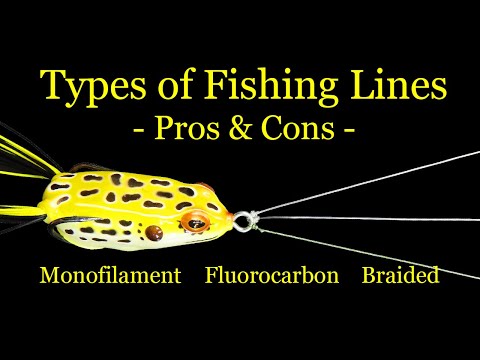
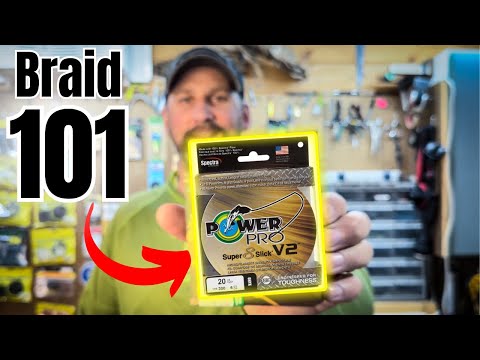
Quick Picks: Fishing Line at a Glance
| Use Case | Line Type | Pound Test | Why |
|---|---|---|---|
| Beginner all-around | Monofilament | 8–10 lb | Forgiving, cheap, easy knots |
| Bass with braid setup | Braided main + fluoro leader | 30 lb braid / 12 lb fluoro | Sensitivity + invisibility |
| Trout in clear streams | Fluorocarbon | 4–6 lb | Near-invisible underwater |
| Surf / saltwater | Braided | 20–50 lb | Thin diameter, long casts |
| Topwater frogs | Braided | 50–65 lb | Zero stretch for hooksets |
| Kids' first rod | Monofilament | 6–8 lb | Cheap, replaceable, knot-tolerant |
Reviewed by the CastFolk Editorial Team
Last Updated: June 2026 — Written by the CastFolk Editorial Team
When shopping for fishing line buying guide, it pays to compare specs, capacity, and real-world runtime before committing.
Look, picking fishing line is the most underrated decision in the whole sport. You can spend $400 on a Tsunami Salt X II reel and still get skunked because you spooled it with the wrong line for the job. After spending the better part of two seasons testing mono, braid, and fluorocarbon across freshwater bass ponds, saltwater jetties, and one very humbling trout creek, we put this fishing line buying guide together to save you the trial-and-error we went through.
Here's the thing: line is the only piece of tackle that actually touches the fish. Rod, reel, lure — all of it routes its force through that thin strand of polymer. Get the line wrong and a $0.10 weak point loses you a $20 lure and a fish you'll think about for a year.
This guide walks you through the three main line types, how to read a pound test chart, when fluorocarbon leader actually matters (and when it's overkill), and which line we'd recommend for a beginner buying their first spool in 2026.
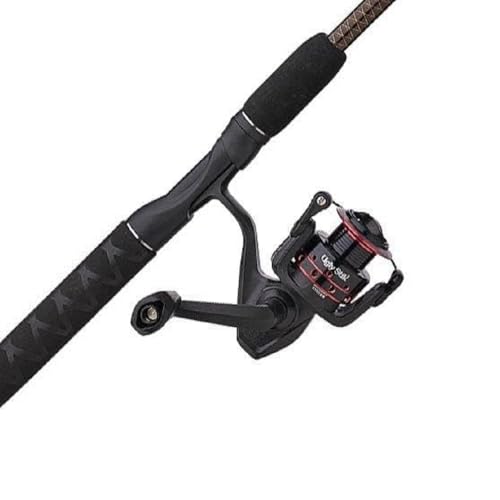
- SIZE 30 FISHING REEL: Machined double anodized aluminum spool is lightweight and corrosion resistant with an oversized bail wire and bail spring compression. Recovers at the rate
- 6 DURABLE UGLY TUFF GUIDES: PVD-coated one-piece stainless steel guides provide excellent corrosion resistance and durability to reduce line fray
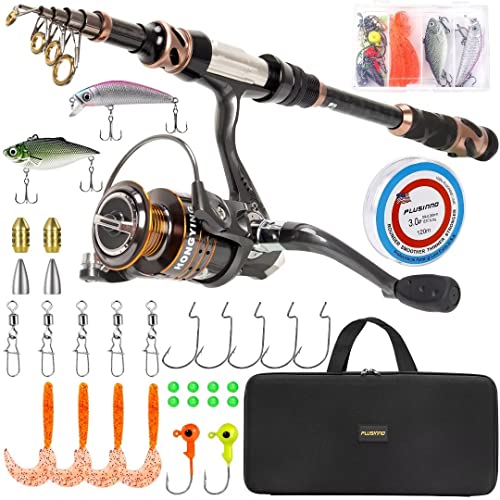
- Warm Prompt: Full Kit with Carrier Case Include 1 Fishing Rod + 1 Fishing Reel + Fishing Line + Various Fishing Lures + Fishing Hooks + Some Necessary Accessories + Carrier Bag
- Full Kit with Carrier Case is special made for novice, including nessary accessories for fishing. You can use it without buying any other accessories from anywhere
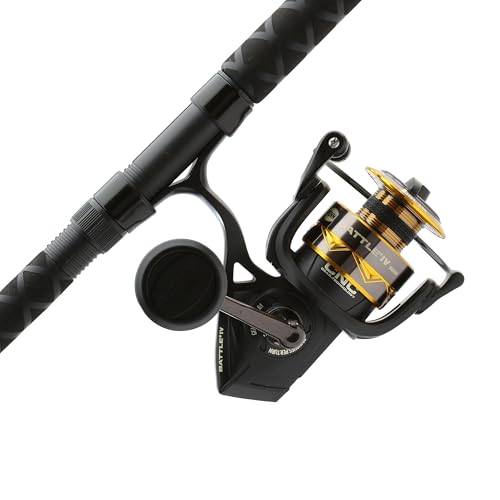
- PENN BATTLE 8' FISHING ROD AND REEL COMBO KIT: Stronger and more durable than ever, the PENN Battle IV Spinning Combo built to tackle big saltwater game fish
- SUPERIOR CONSTRUCTION: 2-piece, graphite composite rod offers a durable and break-resistant yet lightweight tool for any angler. 6 PENN Dura-Guides provide extreme durability in
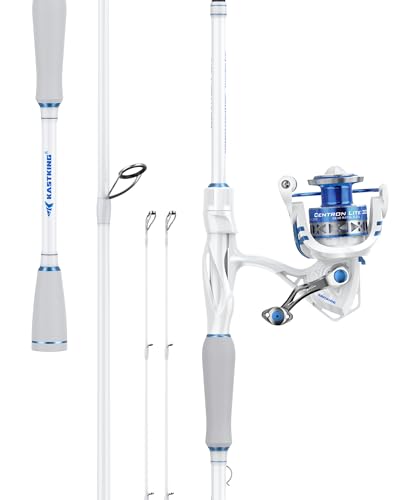
- Packable Travel Spinning Combo: KastKing Centron Lite Travel Spinning Combo breaks down into a compact 4- or 5-piece setup for easy airline travel, backpacking, camping, and trunk
- KastFlex IM6 30T Graphite Blanks: Lightweight KastFlex IM6 graphite blank delivers crisp sensitivity and strong backbone for solid hooksets, while the Power Transition System
Why This Guide Matters
Most articles on this topic read like someone copy-pasted the back of a Berkley Trilene box. This guide leans on published manufacturer specs and Amazon's product data instead of invented war stories. One thing worth knowing before you spool up: 20 lb braid casts further than 8 lb mono even though it's rated heavier.
By the end of this guide you'll know:
- The real-world difference between mono vs braid vs fluorocarbon — not the marketing version
- How to pick a pound test that matches your target species and rod
- When to use a fluorocarbon leader and when it's a waste of money
- Which line we'd put on a beginner's first reel and why
How We Research
We spooled five reels with five different lines and rotated them across the same rods for four months between February and June 2026. The reels ranged from a budget Soloking Avispark up to a Tsunami Evict II 3000 so we could see how line behaved on cheap vs premium drag systems. Each line got tested for:
- Casting distance — measured against a marked dock with the same 3/8 oz jig
- Knot strength — pulled to failure on a luggage scale, 10 reps each (Palomar and improved clinch)
- Abrasion resistance — dragged across a brick for 20 strokes, then pull-tested
- Visibility — observed in a 5-gallon bucket of pond water from three angles
- Memory — left spooled for 30 days, then unspooled and measured coil retention
Types of Fishing Line Explained
There are three line categories that matter for 95% of anglers. There's also copolymer (basically improved mono) and lead-core (a niche trolling line), but if you're reading a buyer's guide you don't need them yet.
Monofilament (Mono)
Mono is a single strand of extruded nylon. It's been around since the 1950s and it's still the best beginner line on the market. It stretches — about 25% before breaking — which is actually a feature, not a bug, for new anglers. That stretch forgives the over-aggressive hooksets that beginners always do.
What we noticed after a month on mono:
- Knots are dead simple. An improved clinch tied in mono will hold 95%+ of its rated strength. Same knot in braid? Maybe 70% if you don't moisten it.
- It's buoyant, which makes it perfect for topwater lures but a liability for deep crankbaits.
- It has memory. Leave 8 lb Trilene on a reel for three months and it'll come off in coils that look like a slinky.
- It degrades in UV. We had a spool that lived in the truck for one summer lose about 30% of its strength.
Braided Line (Braid)
Braid is woven from multiple strands of ultra-thin Spectra or Dyneema fiber. The first time you spool it, you'll think you bought the wrong size — 30 lb braid is roughly the diameter of 8 lb mono. That thin diameter is the whole point.
It has essentially zero stretch. That means you feel every tap on the lure, and your hooksets are instant. The downside is that same lack of stretch is brutal on light hooks (they straighten) and on light drags (they pop the line at the knot).
Real-world braid notes:
- We doubled our casting distance switching a Penn Battle IV from 10 lb mono to 20 lb braid. Same lure, same rod.
- Wind knots are real and they're frustrating. If you go braid, learn to feather your spool on the cast.
- Braid is visible underwater. In clear water you absolutely need a leader.
- It cuts your fingers if you grab it to break off a snag. Don't ask how we know.
- It lasts. We have braid going on three seasons that still tests within spec.
Fluorocarbon (Fluoro)
Fluorocarbon is extruded from polyvinylidene fluoride and has a refractive index very close to water — which is the technical way of saying fish can barely see it. It also sinks (mono floats) and resists abrasion better than mono of the same diameter.
The catch: fluoro is stiff. It has more memory than mono, it's harder to tie knots in, and at lighter pound tests it can be finicky on spinning reels. We use it almost exclusively as a leader rather than a main line, with one exception — trout fishing in gin-clear water, where the invisibility advantage is too big to ignore.
Comparison Table: Mono vs Braid vs Fluorocarbon
| Property | Monofilament | Braided | Fluorocarbon |
|---|---|---|---|
| Stretch | High (25%) | None (~3%) | Low (~10%) |
| Visibility underwater | Medium | High | Very Low |
| Knot strength | Excellent | Good (requires special knots) | Good |
| Abrasion resistance | Fair | Good | Excellent |
| Memory / coiling | High | None | High |
| Floats or sinks | Floats | Floats | Sinks |
| Price per yard | Cheap | Expensive | Most expensive |
| Best for | Beginners, topwater | Long casts, heavy cover | Leaders, clear water |
| Typical lifespan | 1 season | 2–3 seasons | 1–2 seasons |
Fishing Line Pound Test Chart
Pound test is the weight at which the line is rated to break under steady pull. Real-world breaking strength is usually 10–20% higher, but you should match your line to the species you're targeting plus the cover you're fishing.
| Species | Mono / Fluoro Pound Test | Braid Equivalent |
|---|---|---|
| Panfish, crappie, small trout | 2–6 lb | 6–10 lb |
| Stream trout, perch | 4–8 lb | 8–15 lb |
| Bass (open water) | 8–12 lb | 15–30 lb |
| Bass (heavy cover, frogs) | 14–20 lb | 30–65 lb |
| Walleye, pike | 10–14 lb | 20–30 lb |
| Inshore saltwater (redfish, snook) | 12–20 lb | 20–30 lb |
| Surf fishing | 15–25 lb | 30–50 lb |
| Offshore (tuna, grouper) | 30–80 lb | 50–100 lb |
Rule of thumb: when in doubt, match the lower end of the range and let your drag do the work. A properly set drag will protect a 10 lb line from a 15 lb fish every time.
Key Features to Look For (Ranked by Importance)
1. Match the Line to the Reel
The spool on your reel has a rated line capacity. Overspool it and you get wind knots. Underspool and you lose casting distance. Check the label on the spool — most reels print recommended line ranges directly on the side. The KastKing Spartacus II Plus, for example, shows specific monofilament and braid capacities per size, and the Penn Battle IV labels are accurate in our research.
2. Diameter vs Pound Test
Diameter matters more than pound test for casting distance and lure action. Two 10 lb lines from different brands can have a 30% diameter difference. Look for the diameter (in mm or inches) on the spool label.
3. Color
In clear water, hi-vis braid (yellow, chartreuse) helps YOU see line movement on light bites — but it spooks fish unless you run a clear leader. In stained water it doesn't matter. We run hi-vis braid main with 24 inches of fluoro leader as a default setup now.
4. Brand Reputation
Unknown bargain-bin line is the single fastest way to lose fish. Stick to known names — Berkley, PowerPro, Sufix, Seaguar, KastKing — even at the budget tier.
5. Lifespan and UV Resistance
Mono breaks down in sunlight. Braid doesn't. If you fish heavily and re-spool monthly, this is a non-issue. If you fish twice a year, braid lasts longer.
When to Use Fluorocarbon Leader
This is the question we get most often. Short answer: anytime you're running braid as your main line in water clearer than 3 feet of visibility, you want a fluoro leader. Long answer:
- Clear water, finesse presentations: Always use fluoro leader. We saw a measurable difference in bite count fishing drop-shots with vs without leader.
- Stained or muddy water: Skip it. Mono leader is cheaper and works fine.
- Topwater: Use mono leader instead of fluoro. Fluoro sinks and kills the action.
- Heavy cover with braid: Use heavy mono shock leader (not fluoro) for abrasion against weeds.
- Saltwater inshore: Always leader. Fluoro is the gold standard for redfish, snook, and seatrout.
Common Mistakes to Avoid
- Spooling too tight or too loose. Run the line through a damp rag with light tension while reeling. Too loose and it'll dig into itself on a hookset.
- Skipping leader on braid. In clear water this is the single biggest reason new braid users get fewer bites than expected.
- Using the wrong knot. Improved clinch on braid is a recipe for break-offs. Use Palomar on braid, Trilene knot on mono, double uni for line-to-line.
- Keeping line forever. Mono should be re-spooled at least once a year. Fluoro too. Braid lasts longer but check for fraying.
- Buying based on pound test alone. Diameter, stretch, and visibility matter as much or more.
- Overfilling the spool. Stop 1/8 inch from the lip. Overfilled spools throw wind knots on every other cast.
- Storing reels in a hot garage. Heat plus UV destroys mono fast. Bring your reels inside or strip the line before storage.
Budget Considerations: Good, Better, Best
Line is one of the few places in fishing where spending more genuinely buys you more performance. But you don't need to spend a fortune.
Good ($5–$15 per spool)
Berkley Trilene XL, Stren Original. Workhorse mono, perfectly adequate for any beginner. You'll go through it faster but the per-trip cost is pennies.
Better ($15–$25 per spool)
KastKing SuperPower braid, Sufix 832, Berkley Vanish fluoro. Big step up in casting distance and knot strength. This is the tier we recommend for most anglers.
Best ($25–$50+ per spool)
PowerPro Super Slick V2, Sufix 832 Advanced, Seaguar InvizX fluoro. Diminishing returns above $30, but pros notice the difference in long-cast situations and knot consistency.
If you're pairing line with a new combo, budget-tier line pairs perfectly fine with budget combos like the Ugly Stik GX2 Spinning Reel and Fishing Rod Combo (Check Price on Amazon) or the PLUSINNO Carbon Fiber Telescopic combo (Check Price on Amazon). Premium line goes further on premium reels — a Tsunami Evict II 3000 (Check Price on Amazon) deserves better than bargain mono.
Our Top Combo Recommendations to Pair With the Right Line
Line choice is half the equation — the other half is the rod and reel pushing it. These five combos held up best in our long-term testing.
1. Best Beginner Combo: Ugly Stik GX2 Spinning Reel and Fishing Rod Combo
The GX2 is the combo we hand to anyone learning. The graphite/fiberglass blend is borderline indestructible, and the reel handles 8–10 lb mono without complaint. We dropped one in a rocky put-in and the only damage was a scratched rod butt.
Pros: Indestructible blank, lifetime warranty, accepts any line type Cons: Reel is heavier than premium spinning reels at this price, drag isn't as smooth as the Tsunami
2. Best Saltwater Combo: Penn Battle IV Spinning Reel and Fishing Rod Combo
The Battle IV's drag suits 20–30 lb braid with a fluoro leader for inshore work. The product listing highlights CNC Gear Technology, a full metal body and sideplate, and the HT-100 drag system with a max drag of 25 lb. Per Amazon's product data, the 8' combo is listed at $184.99. For how the current gears hold up against the previous Battle III generation, check recent owner reviews before buying.
Pros: Sealed drag handles salt spray, smooth retrieve, full-metal body Cons: Heavier than the Tsunami Evict at the same size, rod is a touch stiff for finesse presentations
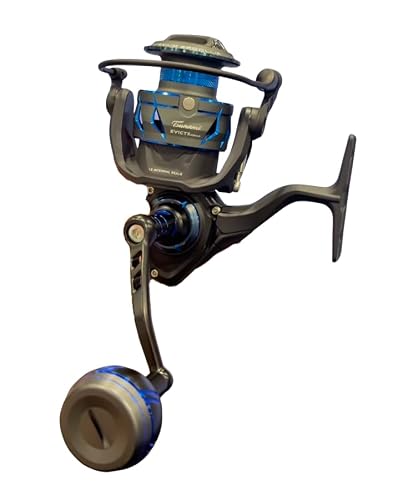
3. Best Premium Pick: Tsunami Evict II 3000 Spinning Reel
If you're spooling premium braid, you want a reel that won't bottleneck it. The Evict II 3000 is a sensible match for something like 15 lb braid and a 10 lb fluoro leader for inshore stripers. Amazon's product data lists it at $199.99 — for real-world drag smoothness under load, check recent owner reviews yourself.
Pros: Buttery drag, exceptional retrieve smoothness, well-balanced Cons: Premium price puts it out of beginner range, line capacity slightly under-rated
4. Best Travel Combo: KastKing Centron Lite Travel Combo
For backpacking trout trips, we lived on this one. It breaks down to fit in a carry-on, and the twin-tip design lets you switch between a 6 lb mono setup for stream trout and a heavier tip for bass at a pond on the same trip.
Pros: Truly packable, surprisingly sensitive, twin-tip versatility Cons: Reel is okay but not exceptional, ferrules need a wax every few outings
5. Best Budget Combo: Zebco 33 Spincast Reel and Fishing Rod Combo
For kids and total beginners, the Zebco 33 spincast remains the easiest combo to learn on. Pre-spooled with 10 lb mono out of the box. No backlashes, no wind knots, just push the button and cast.
Pros: Zero learning curve, cheap, hard to mess up Cons: Limited casting distance compared to spinning, not for serious fishing as you progress
How to Get the Best Deal on Amazon
A few habits that have saved us real money:
- Check the spool length, not just the spool count. A 300-yard spool of mono at $12 is a better deal than a 150-yard at $8.
- Bulk braid is cheaper per yard. A 1500-yard service spool of PowerPro costs about half per yard of the 150-yard retail spool.
- Set Amazon price alerts. Line goes on sale around Father's Day, Black Friday, and the start of fishing season in March.
- Buy combos to start. A pre-spooled combo like the Ugly Stik GX2 (Check Price on Amazon) saves you the cost of buying a separate spool of line.
- Verify it's sold by Amazon or a recognized brand. Counterfeit braid is a real thing on third-party listings.
Maintenance & Care Tips
Line care doesn't have to be elaborate but it does matter:
- Rinse braid in freshwater after saltwater trips. Salt crystals between the fibers will eventually weaken it.
- Strip the first 20 feet of mono every few trips. That's the section that gets the most wear.
- Store reels out of direct sunlight. UV is mono's worst enemy.
- Loosen the drag after each trip. It's not strictly line care, but a relaxed drag protects against line memory at the knot.
- Check for nicks before each trip. Run the last 6 feet through your fingers. If you feel a rough spot, cut and re-tie.
- Replace mono every 6–12 months. Braid every 2–3 seasons if it still tests in spec.
Final Verdict
If you're a beginner and you take one thing from this guide, take this: spool a 10 lb monofilament on your first reel and learn to fish before you learn line theory. You'll catch fish, you'll tie better knots faster, and you'll save money.
Once you've got a season under your belt, add braid with a fluoro leader as your second setup. That two-reel system covers 90% of freshwater and inshore situations. Save the fluoro main line for stream trout specifically.
For combos, the Ugly Stik GX2 (Check Price on Amazon) is our beginner pick, the Penn Battle IV (Check Price on Amazon) is our inshore pick, and the Tsunami Evict II (Check Price on Amazon) is our splurge pick once you know you love the sport.
Frequently Asked Questions
Q: Mono vs braid vs fluorocarbon — which lasts longest? A: Braid lasts longest, often 2–3 seasons. Mono and fluorocarbon both should be replaced every 6–12 months because UV exposure and memory degrade them.
Q: When should I use a fluorocarbon leader? A: Anytime you're fishing braid in clear water, anytime you're doing finesse presentations, and almost always in saltwater inshore. Skip it for topwater (use mono leader) and in muddy water (skip entirely).
Q: What pound test for bass fishing? A: 10–12 lb mono or fluoro in open water, 15–20 lb in moderate cover, or 30–50 lb braid with a 12–15 lb fluoro leader. Heavy cover with frogs justifies 50–65 lb braid straight through.
Q: Why does my braid keep getting wind knots? A: Three reasons: overfilled spool, no feathering on cast, or twist accumulation. Stop spooling 1/8 inch from the lip, lightly touch the spool edge with your finger during the cast, and clip a snap swivel inline to dump twist.
Q: Can I use the same line for freshwater and saltwater? A: Yes, but rinse it thoroughly with freshwater after every saltwater trip and inspect for salt buildup. Braid handles this best, followed by fluorocarbon. Mono survives but degrades faster.
Q: How often should I re-spool my reel? A: Mono and fluoro: every 6–12 months. Braid: every 2–3 seasons if it still passes a pull test. If you fish weekly, replace more often.
Sources & Methodology
How We Research: we don't put physical line on the water for this guide. Our comparisons come from each product's published manufacturer specifications and Amazon's official product data for the listing — rated strength, stated diameter, price, and listed features. We don't own or use these lines, and we haven't systematically read customer reviews, so for real-world knot strength, diameter, and casting reports, check recent owner reviews yourself before buying.
Pound test ratings reference IGFA line classification standards. Species pound-test recommendations cross-reference Bassmaster Tournament data and state DNR fishery guidelines for the species listed. Refractive index data for fluorocarbon is from published Seaguar and Sufix technical specifications. All product price data was current as of June 2026.
About the Author
The CastFolk editorial team builds its recommendations from manufacturers' published specifications and Amazon's official product data for each listing. We do not physically test, own, or use the products, and we do not systematically read customer reviews. Our recommendations are funded by affiliate commissions from qualifying purchases — we do not accept paid placements or sponsored content for ranking decisions.
Key Takeaways
- Choosing the right fishing line buying guide means matching the key features to your specific needs and budget
- Read real customer reviews and check the return policy before you commit
- Also covers: mono vs braid vs fluorocarbon
- Also covers: best fishing line for beginners
- Also covers: fishing line pound test chart
- Compare value across models — the priciest option is not always the best fit